

If you’ve ever been to Milos in Greece before, I’m sure you’ll agree that the people are incredibly friendly and welcoming. However, while there are around 5,000 people who call Milos their home, the number of cats far exceeds this! And so, while tourists snap photos of the famous volcanic beaches, the real stars of Milos, with their aloof stares and perpetual lounging, are the island’s stray cats, who have turned this Aegean paradise into their personal kingdom.
Before going to Milos, I had no idea about the many cats roaming the island. They were literally everywhere: in the streets; on the beaches; roaming the restaurants; the list goes on. I myself am quite a cat person, and so I was absolutely thrilled at the thought of spending the next week making millions of feline friends. However, the sheer number of stray cats does raise important questions about animal welfare and sustainability. While it’s easy to be charmed by their presence, the reality is that Milos, like many Greek islands, faces challenges as a result. There are limited resources for sterilisation programs to combat overpopulation concerns, and animal welfare becomes a great issue as a result. So the question stands: why are there so many cats, why is this a problem, and what can we do to help?

Meet Masende: a fun-loving ginger kitty who joined me for breakfast each morning.
Why are there so many stray cats in Milos, Greece?
The first question people ask themselves when finding themselves surrounded by cats on Milos island is how and why they got here. First and foremost, since there are no major predators on the island, cats find themselves very near the top of the foodchain. They are the hunters rather than the hunted, allowing them the freedom to roam and reproduce without any significant threats. While some may assume that humans would be threats to the cats, the opposite is true: both locals as well as tourists enjoy putting out food and water on a daily basis. Often, patrons at restaurants happily share their meals with the cats sitting near their tables. This creates an abundance of food for the cats, further allowing their thriving population growth. Finally, Milos does not have sufficient resources to implement comprehensive spay and neuter programs. There are organisations such as Milos Friends of the Animals who have made an active effort to implement such programs, however with the large scale at hand, this is no small task. As a result, the cats can reproduce and continue to grow their population without restriction.

Meet Love: she ran after me on a street one day and, when she caught up, continued to purr and rub herself against me. We hung out for the next half hour just loving!
Why is this a problem?
The overpopulation of stray cats on Milos island presents several challenges for both the environment as well as the local community. Ecologically, these cats can significantly impact native wildlife by preying on birds and other small animals. While this is a natural process in ordinary contexts, since the cat population here is so extensive, it disrupts the island’s natural balance and threaten its biodiversity. Additionally over time, the cats may exhaust their natural prey, resulting in a significant decline in local wildlife populations and forcing the cats to rely more heavily on human sources for food. This can increase tensions between the cats and residents, as well as lead to further ecological imbalances.
Health and sanitation issues also arise, as stray cats can spread diseases and parasites to humans and other animals. Moreover, the cats themselves often suffer due to inadequate access to water, shelter, and veterinary care, raising significant animal welfare issues. In the Summer months it gets incredibly hot on the island, and while cats located in populated areas may receive food and water from residents, those located in less populated areas suffer from severe dehydration. For this very reason I always had the boot of my car filled with bottles fo water, just in case I came across any cats in need.
Without effective management and intervention, the stray cat population will continue to grow, exacerbating these problems and creating further challenges for Milos and its cats.
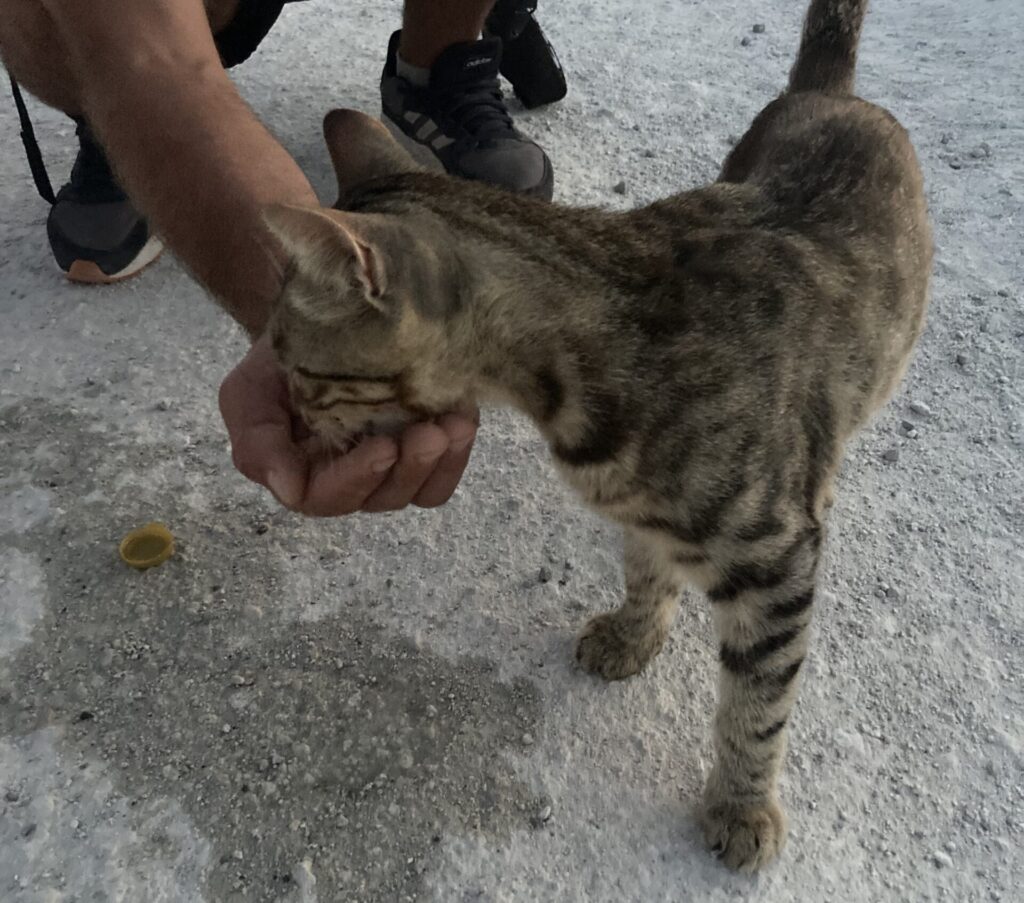
Meet Stripe: he saw me with a bottle of water and ran after me meowing. He drank almost half of a litre of water out of my hand!
What can we do to help?
Addressing the stray cat problem in Milos requires a collaborative effort from locals, tourists, and animal welfare organisations. First and foremost, supporting and participating in spay and neuter programs is crucial to control the population and prevent further growth. Tourists can contribute by donating to local animal shelters or international organisations that fund sterilisation and care initiatives.
Additionally, advocating for policies that promote humane animal management and ensure that resources are allocated to sustainable solutions can help create lasting change on the island. Through these combined efforts, we can work towards a balanced coexistence between humans and the feline inhabitants of Milos.
What is it like to experience the cats first-hand?
The cats in Milos may be wild, but they are so unbelievably calm and loving. They all want to be cuddled and nurtured, and in my experience they are in no way aggressive towards people. Cats approached me from all angles, some wanting to be held and others wanting to be fed. For the most part, they seemed to crave human attention and companionship, eagerly purring and rubbing against my legs whenever I sat down. This gentle and affectionate demeanor made it easy to fall in love with them and sparked a desire to do more to help improve their living conditions. Despite their tough circumstances, their friendly nature showed their resilience and adaptability, leaving a lasting impression on my heart and inspiring me to learn more about how I could contribute to their welfare.

Meet Nystazo: the sleepiest kitty in all of Milos.
With its combination of landscapes, locals and four-legged felines, Milos offers visitors an especially unique experience. The charming cats have undoubtedly become an integral part of the island’s character. While their presence raises important challenges, it also presents an opportunity for us to show compassion and care. So the next time you find yourself relaxing on Sarakiniki beach, take a moment to appreciate the cats that make Milos truly special and consider how you might help make their lives a little brighter. After all, where else can you enjoy such stunning sunsets with a furry friend by your side?